
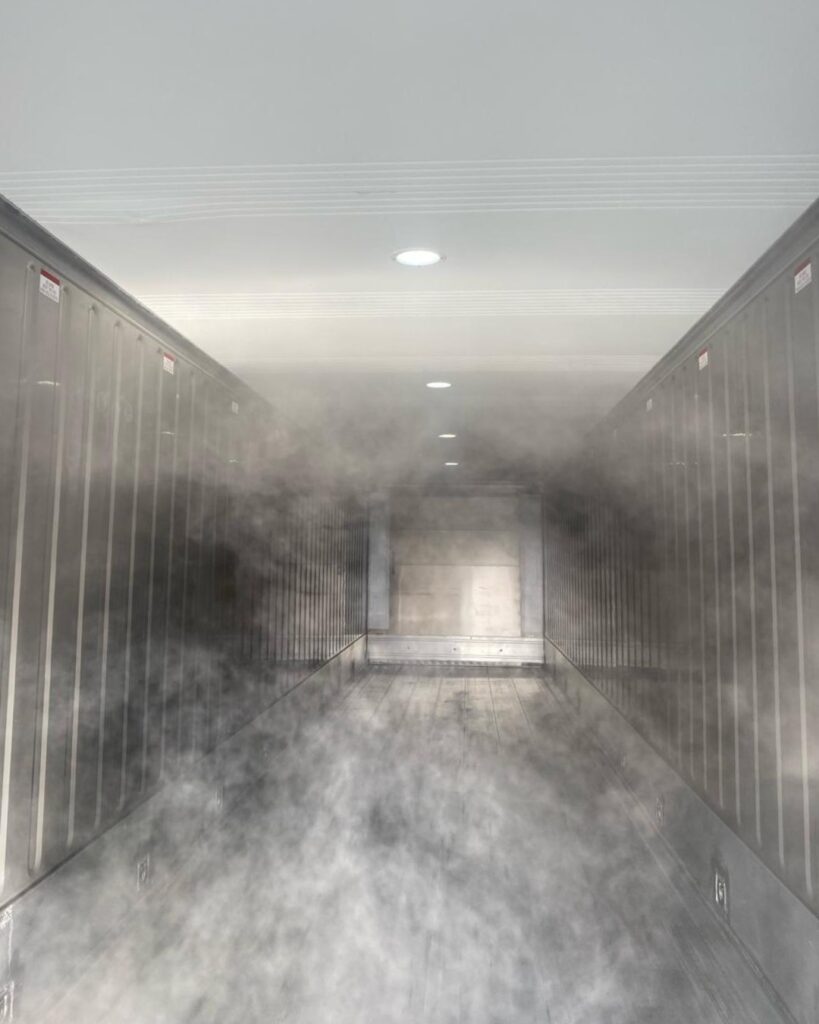
When you decide to invest in a mobile cold room, the initial purchase price is only one part of the equation. Most savvy business owners quickly realize that understanding the 40ft reefer container power consumption is the true key to long-term profitability. Whether you are running a large-scale agricultural operation in California or a pharmaceutical distribution hub in New Jersey, your monthly utility bill will depend heavily on how efficiently your unit operates. Fortunately, Steel Works Shipping Containers provides high-efficiency refrigerated units designed to keep your operational costs as low as possible.
Initially, it might seem like a refrigerated container would drain a massive amount of electricity. However, modern engineering has come a long way. In 2026, the average 40ft reefer container power consumption is surprisingly manageable, provided you are using the right equipment and following best practices for insulation and maintenance.
The Fundamentals of 40ft Reefer Container Power Consumption
To get a clear picture of your potential costs, you must first look at the technical requirements of these machines. Typically, a refrigerated unit requires a 460V, 3-phase power supply to run its cooling compressor. Initially, the unit pulls more power during the “pull-down” phase—this is the period when the machine is working hard to drop the internal temperature to your desired set point. Once the container reaches that temperature, the 40ft reefer container power consumption drops significantly as the machine enters its maintenance cycle.
Furthermore, the external environment plays a massive role. For instance, a unit sitting in the intense heat of Houston or Laredo, Texas, will naturally work harder than one located in the cooler climate of Seattle, Washington. Therefore, when Steel Works Shipping Containers delivers a unit to a high-heat zone, we recommend specific shading and ventilation strategies to help reduce the overall 40ft reefer container power consumption.
Regional Factors: How Geography Impacts Your Bill
Because Steel Works Shipping Containers operates across a vast network of cities, we see firsthand how regional climates affect energy usage.
The Southern Heat: Texas, Florida, and Georgia
In states like Texas, we deliver to Dallas, Fort Worth, and San Antonio, as well as McAllen, Brownsville, and Corpus Christi. In these areas, the 40ft reefer container power consumption can spike during the summer months. Similarly, our clients in Florida—including those in Miami, Jacksonville, Tampa, and Orlando—must account for high humidity. Because humid air holds more heat, the cooling units in Fort Lauderdale, Hialeah, and Port St. Lucie may run longer cycles. In Georgia, we serve Atlanta, Savannah, Augusta, and Columbus, where we consistently advise clients on how to optimize their settings to save on energy.
The West Coast: California and the Southwest
In California, we service the massive hubs of Los Angeles, Long Beach, and Oakland, along with the Inland Empire cities of Riverside, San Bernardino, and Stockton. While the coastal breeze helps in San Diego, units in Sacramento, Fresno, and Bakersfield face dry, intense heat. Moreover, in the high deserts of New Mexico, specifically Albuquerque and Santa Fe, the thin air and high sun exposure can influence 40ft reefer container power consumption. Steel Works Shipping Containers ensures that every unit sent to these regions features premium insulation to act as a thermal barrier.
Efficiency in the Heartland and Canada
Moving into the Midwest, we support businesses in Memphis and Nashville, Tennessee, as well as Kansas City and St. Louis, Missouri. In these regions, the 40ft reefer container power consumption is often more stable due to more moderate average temperatures. We also provide units to Oklahoma City and Tulsa, Oklahoma, and the industrial centers of Milwaukee and Green Bay, Wisconsin.
The Canadian Connection
The same principles of efficiency apply north of the border. In British Columbia, we deliver to Vancouver, Surrey, and Richmond, where the mild Pacific climate is ideal for low-energy cooling. However, for our clients in Quebec, specifically Montreal, Quebec City, and Laval, the winter months present a different challenge. While the cooling unit doesn’t have to work as hard, the 40ft reefer container power consumption might include the use of internal heaters to prevent sensitive cargo from freezing. Whether you are in Gatineau, Longueuil, or Sherbrooke, we provide the right specs for your province.
Technical Secrets to Lowering Your Energy Costs
Instead of just accepting a high utility bill, there are several active steps you can take to lower the 40ft reefer container power consumption of your unit.
- Check the Seals: Initially, you should inspect the door gaskets. If cold air is escaping, your compressor will run indefinitely. Steel Works Shipping Containers ensures that every unit we sell has airtight seals before it leaves our yard.
- Pre-Cool Your Cargo: This is a vital step. If you load warm products into the container, the 40ft reefer container power consumption will skyrocket as the unit struggles to remove that latent heat. Always try to load items that are already at or near their target temperature.
- Optimize Airflow: Never block the “red line” near the ceiling. Proper airflow allows the unit to cool the space evenly and shut off sooner.
- Regular Maintenance: Dust and debris on the condenser coils act as an insulator, forcing the machine to work harder. A simple cleaning can drop your 40ft reefer container power consumption by 10% or more.
Why Buying from Steel Works Saves You Money
Ultimately, the quality of the machinery determines your energy efficiency. At Steel Works Shipping Containers, we primarily stock units equipped with Tier 1 machinery from leaders like Carrier and Thermo King. These brands are the gold standard for low 40ft reefer container power consumption because they utilize digital scroll compressors and high-efficiency fans.
Furthermore, we don’t just sell you the box and disappear. We provide a comprehensive guide on how to hook up your unit to minimize line loss and voltage drops. Whether you are in Wichita, Kansas, or Kenosha, Wisconsin, our goal is to make sure your refrigerated storage is an asset, not a financial drain. Consequently, many of our clients find that their 40ft reefer container power consumption costs are much lower than the fees they were previously paying for third-party cold storage.
Ownership vs. Rental: The Energy Perspective
When you rent a container, you often get whatever unit is available, which might be an older, power-hungry model. However, when you look for a 40ft reefer container for sale through Steel Works Shipping Containers, you can choose a unit specifically rated for high efficiency. Over the course of a few years, the savings in 40ft reefer container power consumption can actually pay for a significant portion of the initial purchase price.
Similarly, owning your unit means you can invest in permanent site improvements, such as a dedicated 460V power drop or a permanent shade structure. These small investments lead to a massive cumulative reduction in your 40ft reefer container power consumption. Whether you are located in Memphis, Tennessee, or Laval, Quebec, the logic remains the same: efficiency equals profit.
Final Thoughts: Making the Smart Energy Choice
In conclusion, understanding 40ft reefer container power consumption is about taking control of your operational overhead. By choosing a high-quality unit from Steel Works Shipping Containers, you are starting with a foundation of efficiency. We manage the logistics and delivery to cities like Albuquerque, New Mexico, and Chicago, Illinois, ensuring that you receive a machine that is tested, cleaned, and ready to perform.
Don’t let the fear of electricity costs keep you from the convenience of on-site cold storage. With the right equipment and a few smart habits, your 40ft reefer container power consumption will be a minor line item in a much more profitable business model. We are ready to help you find a unit that fits both your space requirements and your energy goals.


