
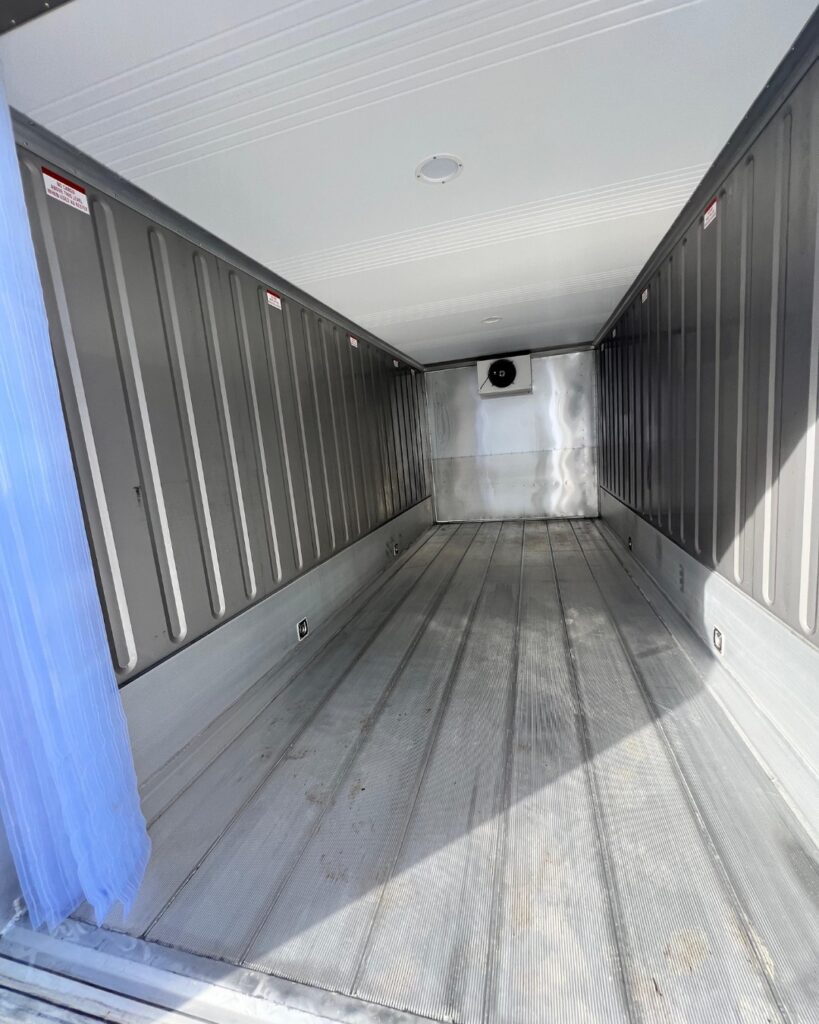
To truly master the logistics of temperature-sensitive goods, one must first explain the function of a 40ft reefer container as more than just a large fridge. In 2026, these units serve as the high-tech backbone of the global supply chain, allowing everything from lifesaving vaccines to peak-season blueberries to travel thousands of miles without degrading. At Steel Works Shipping Containers, we believe that when you understand the complex mechanics behind the metal, you can better leverage these assets for your business’s growth.
Whether you are operating a vineyard in California or a pharmaceutical lab in New Jersey, the primary goal of a reefer is not actually to “chill” warm cargo, but rather to maintain a precise, pre-set environment. Initially, this distinction might seem minor, but it is the secret to successful long-term storage.
The Core Mechanics: How Cooling Actually Happens
If we are to explain the function of a 40ft reefer container simply, we must look at the refrigeration unit at the front of the box. This unit works on a continuous closed-loop cycle involving a compressor, a condenser, and an evaporator.
Initially, the compressor pressurizes a refrigerant gas, which then moves through the condenser coils to release heat to the outside air. Furthermore, the liquid refrigerant travels to the evaporator inside the container, where it absorbs heat from the interior air and turns back into a gas. This cycle repeats endlessly to keep the internal climate stable. Because Steel Works Shipping Containers provides units with advanced microprocessors, this entire process is monitored in real-time. Consequently, if the temperature deviates by even a fraction of a degree, the system automatically adjusts to compensate.
Airflow: The Secret Variable
To fully explain the function of a 40ft reefer container, we must discuss the “bottom-air” delivery system. Unlike your home refrigerator, which blows air from the top or back, a reefer pushes chilled air down into the floor.
The floor of a 40ft reefer is made of aluminum “T-bars.” These bars act as tiny wind tunnels that guide the cold air underneath the entire length of the cargo. As the cold air moves toward the back doors, it naturally rises, absorbing heat from the products as it travels upward. Finally, the air is sucked back into the intake at the top of the refrigeration unit to be cooled again. Therefore, the function of a 40ft reefer container is essentially a massive, controlled convection current.
Global Reach: Delivering Functionality to Your City
Because the function of a 40ft reefer container is so specialized, Steel Works Shipping Containers ensures that our delivery network spans the most critical economic zones in North America. We don’t just drop off a box; we provide an infrastructure solution tailored to your local environment.
The Western United States
In California, we serve the busy ports of Los Angeles, Long Beach, and Oakland. Furthermore, we deliver to the Inland Empire, supporting businesses in Riverside, San Bernardino, Stockton, and Sacramento. If you are in Fresno, Bakersfield, or San Diego, we can explain the function of a 40ft reefer container in the context of the intense Central Valley heat, ensuring your unit is positioned for maximum efficiency.
The Southern and Eastern Hubs
Texas is a primary market where we deliver to Houston, Dallas, and Fort Worth, alongside border cities like Laredo, El Paso, and San Antonio. In Florida, we cover Miami, Jacksonville, Tampa, and Orlando, reaching as far as Tallahassee and Port St. Lucie. Similarly, in Georgia, we serve Atlanta, Savannah, and Augusta. Whether you are in Macon, Garden City, or Gainesville, the function of a 40ft reefer container is vital for protecting high-value exports from the southern humidity.
The Industrial Heartland
In Tennessee, we support the logistics giants in Memphis and Nashville, as well as Knoxville and Chattanooga. Moving into Missouri, our network covers Kansas City and St. Louis. In Oklahoma, we serve Oklahoma City and Tulsa. Furthermore, we provide units to the rail-dense areas of Chicago, Illinois, and the pharmaceutical corridors of Newark and Jersey City, New Jersey. In these regions, we often explain the function of a 40ft reefer container as a “plug-and-play” cold room for seasonal overflows.
Serving Canada: BC and Quebec
The function of a 40ft reefer container is equally critical in the colder climates of the North, where the unit often switches from “cooling” to “heating” to prevent products from freezing.
British Columbia
In BC, we focus on Vancouver and Surrey, along with Richmond, Burnaby, and Coquitlam. From the agricultural hubs in Delta and Kelowna to Victoria, we provide reefers that handle the Pacific moisture with ease.
Quebec
In Quebec, we deliver to Montreal, Quebec City, and Laval. Furthermore, we support Gatineau, Longueuil, and Sherbrooke. In these areas, we explain the function of a 40ft reefer container as a thermal shield that protects sensitive electronics and chemicals from the sub-zero Canadian winter.
Beyond Temperature: Humidity and Gas Exchange
When we explain the function of a 40ft reefer container, we must also mention its ability to manage the “atmosphere” inside. For instance, fresh fruits and vegetables are living organisms that “breathe” oxygen and release ethylene gas as they ripen.
Initially, a standard reefer might allow these gases to build up, which would cause the produce to spoil prematurely. However, high-spec units from Steel Works Shipping Containers feature fresh air exchange vents. These vents allow the unit to “exhale” ripening gases and “inhale” fresh air. Furthermore, the dehumidification function can pull moisture out of the air to protect dry goods like cardboard packaging or certain pharmaceuticals. Consequently, the function of a 40ft reefer container is to act as a complete life-support system for your inventory.
The Power of the “High Cube” Advantage
At Steel Works Shipping Containers, we primarily offer “High Cube” models because they enhance the function of a 40ft reefer container. By adding an extra foot of height, these units provide more “headroom” for the air to circulate.
Initially, you might be tempted to stack pallets all the way to the ceiling. However, the function of a 40ft reefer container relies on that top gap. If you block the airflow, you create “hot spots” where cargo can rot despite the machine running at full power. Therefore, the High Cube design isn’t just about more space—it is about better air physics. Because our units are 2026-ready, they often include “red line” markers inside the box to show exactly where your loading limit should be.
Why Choose Steel Works Shipping Containers?
Ultimately, the best way to explain the function of a 40ft reefer container is through reliability. A reefer is a complex machine with many moving parts. If the compressor fails or the insulation degrades, your entire investment is at risk.
Steel Works Shipping Containers provides peace of mind by:
- Pre-Trip Inspections (PTI): We run every unit through a multi-hour stress test before it leaves our yard.
- Stainless Steel Interiors: We ensure the food-grade lining is intact and easy to sanitize.
- Expert Support: We help you understand the power requirements—typically a 460V 3-phase connection—so you are ready to go the moment we arrive.
Instead of navigating the used market alone, let us provide a unit that functions exactly as it should. We handle the logistics, the technical checks, and the delivery to cities like Albuquerque, New Mexico, or Wichita, Kansas, so you can focus on your business.
Conclusion: Your Cold Chain Partner
In conclusion, to explain the function of a 40ft reefer container is to describe a perfect balance of thermodynamics, air circulation, and structural engineering. Whether you are in Milwaukee, Wisconsin, or Seattle, Washington, these containers offer a portable, scalable solution to your most difficult storage challenges.
Steel Works Shipping Containers is dedicated to bringing this level of functionality to your doorstep. Don’t let your cold chain be the weak link in your business. Let us provide the steel-clad reliability you need to succeed in 2026.


